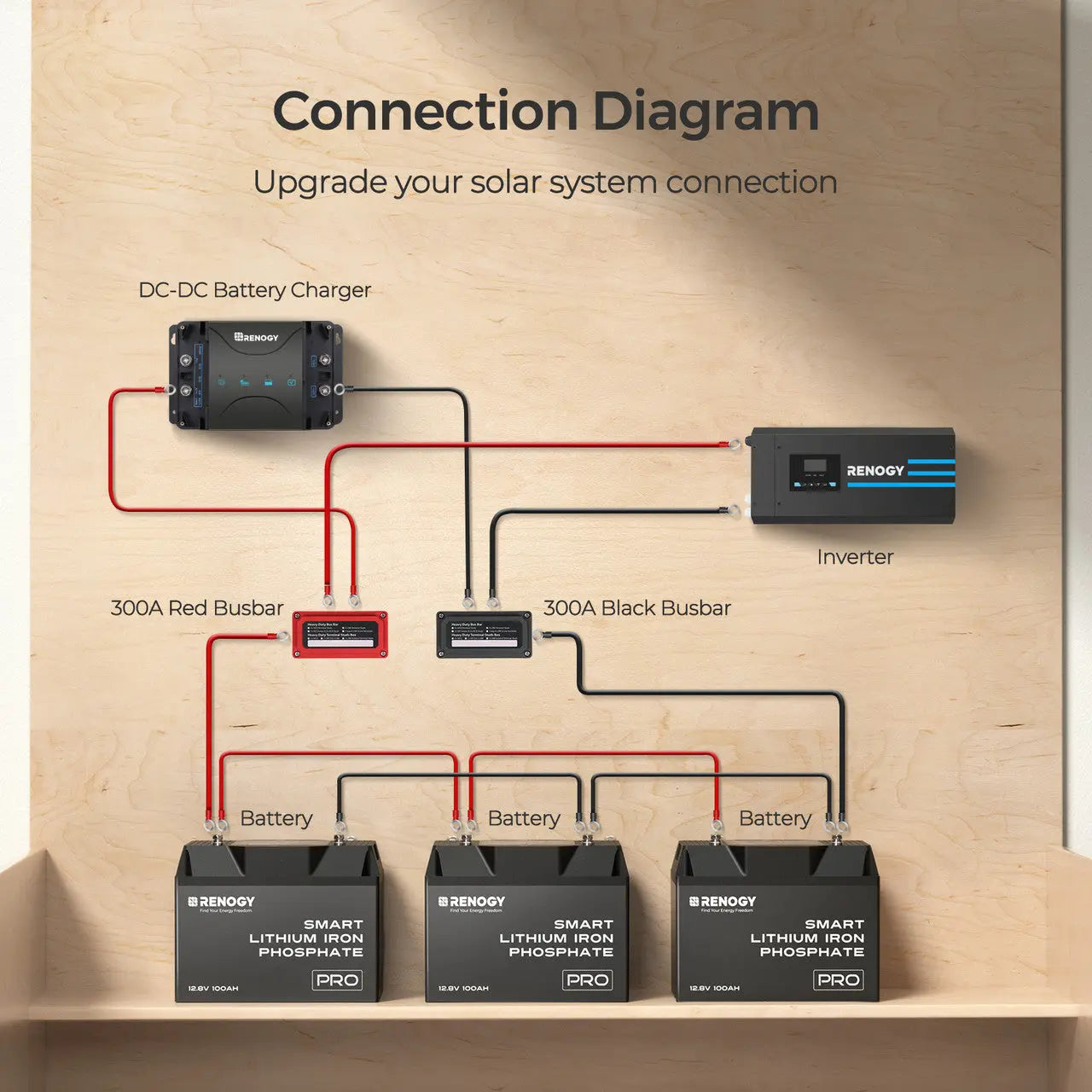
A busbar is the backbone of any properly-wired 12V system. Instead of stacking every component onto your battery terminals (messy, dangerous, and a code violation on most permanent installs), every positive wire lands on the red busbar and every negative wire lands on the black busbar. One clean hub, labeled connections, easy to service.
Why You Need a Busbar
Clean wiring - no stacked lugs on battery terminals, no bird's nest
Serviceable - add, remove, or troubleshoot any component without disturbing the rest of the system
Safer - distributes heat and fault currents across a proper conductor instead of overloading a single battery stud
Expected by inspectors - ABYC and most RV / van certifiers expect bus bars on any permanent install
100A vs 300A - Which Size?
Busbar
Use For
100A
Small van setups, overlanding kits, 1000W inverters and smaller, DC-loads-only builds
300A
Full-time van builds, off-grid cabins, 2000W-3000W inverters, induction cooking, high-current systems
Red + Black - You Need Both
A working system needs one red (+) and one black (-) busbar. The red busbar collects all positive leads (battery +, charge controller +, DC-DC charger +, inverter +, DC loads +). The black busbar collects all negative leads through the shunt, so every amp in or out of the battery is measured by your battery monitor.
Specs
Max voltage: 48V DC
Max continuous current: 100A or 300A (per variant)
Conductor: Nickel-plated brass - high conductivity, corrosion resistant
Housing: Glass fiber / nylon, flame retardant
Mounting: Surface mount, any orientation, 4 fixing screws included
Removable windows: Flexible wire routing from any side
Labelable top: Write circuit names directly on the housing
Not sure how to wire it into your build? See our free System Build Helper - shows exactly where the busbar fits in your power system diagram.
🛡️
100% Genuine RenogyBrand-new, sourced through authorized US distribution
📜
Licensed SC RetailerSC Retail License #122143304
🔒
Secure CheckoutSSL-encrypted — we never store your card
↩️
30-Day ReturnsBacked by the full manufacturer warranty
🚚
Ships from the USAFrom our authorized distributor partners